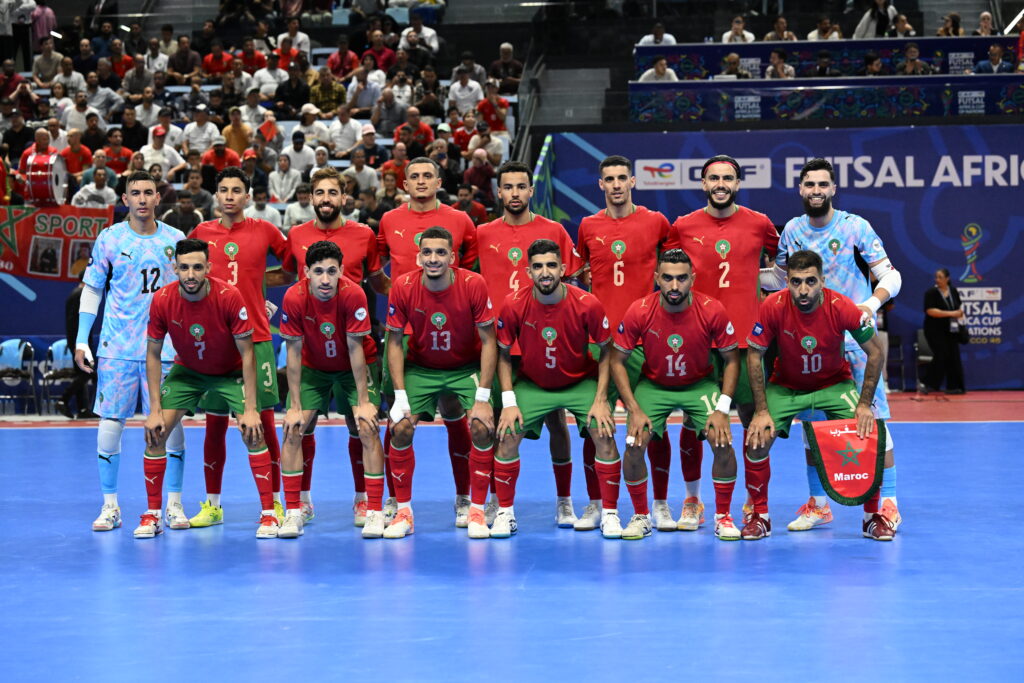
Morocco has become one of the leading nations in international futsal, combining sustained African success with increasingly strong performances on the world stage. The national team, coached by Hicham Dguig, has won the CAF Futsal Africa Cup of Nations four times: in 2016, 2020, 2024 and 2026. Its latest triumph came on home soil in Rabat, where Morocco defeated Angola 5–2 in the final on 21 October 2026. The victory made Morocco the first nation to win the continental futsal title four times and extended its run of championships to three consecutive editions.
Morocco futsal achievements: a record four African titles
The most important measure of Morocco’s rise is its record in the CAF Futsal Africa Cup of Nations. The Atlas Lions first lifted the trophy in 2016, defended it in 2020, won it again in 2024 and retained it in 2026. The four titles place Morocco alone at the top of the competition’s honours list, ahead of Egypt, which won the first three editions in 1996, 2000 and 2004, and Libya, the 2008 champion.
| Year | Achievement | Final / key detail |
|---|---|---|
| 2016 | CAF Futsal AFCON champions | Morocco’s first continental title |
| 2020 | CAF Futsal AFCON champions | Successfully defended the title |
| 2021 | FIFA Futsal World Cup quarter-finalists | Reached the last eight in Lithuania |
| 2022 | Arab Futsal Cup winners | Second consecutive Arab title |
| 2023 | Arab Futsal Cup winners | Completed a third consecutive Arab title |
| 2024 | CAF Futsal AFCON champions | Beat Angola 5–1 in the final in Rabat |
| 2024 | FIFA Futsal World Cup quarter-finalists | Reached the last eight in Uzbekistan |
| 2026 | CAF Futsal AFCON champions | Beat Angola 5–2 in the final in Rabat |
Competition note: the CAF Futsal Africa Cup of Nations has not always followed a fixed two-year calendar. The years above refer to the editions in which Morocco won the title, not to a claim that the tournament was staged every two years.
The 2016 breakthrough and the 2020 title defence
Morocco’s first CAF futsal crown arrived in 2016, marking a major turning point for the national programme. The title established the Atlas Lions as a serious force in African indoor football and gave the team a platform to build on. Morocco then defended its continental crown in the 2020 edition, showing that the first success was not a one-off achievement. The back-to-back titles helped create the foundations for the team’s later run of dominance.
Morocco’s progress at the FIFA Futsal World Cup
Morocco’s achievements are not limited to Africa. The national team reached the quarter-finals of the FIFA Futsal World Cup in 2021 and repeated that achievement in 2024. Those consecutive appearances in the last eight confirmed that Morocco could compete beyond its continent and face established futsal nations at the highest level. CAF’s team profile also records four FIFA Futsal World Cup appearances between 2012 and 2024.
The 2024 tournament in Uzbekistan was another important milestone. Morocco advanced from the group stage and continued into the knockout rounds before its campaign ended in the quarter-finals. Reaching the same stage in two successive World Cups is a significant achievement for an African national team and reflects the progress made in coaching, tactical organisation and player development.
Three consecutive Arab Futsal Cup titles
Morocco has also enjoyed success in regional competition. The official Moroccan government portal lists the national futsal team as the winner of the Arab Futsal Cup in 2021, 2022 and 2023. Three successive titles added another achievement to the team’s record and demonstrated its ability to maintain a high level across different competitions and formats.
The 2024 African title: a dominant final against Angola
Morocco won the 2024 CAF Futsal Africa Cup of Nations on 21 April in Rabat, defeating Angola 5–1 in the final. The victory secured a third continental crown and a third title in succession. CAF reported that Morocco also dominated the individual awards: Bilal Bakkali was named Player of the Competition, Abdelkrim Anbia won Best Goalkeeper, and Soufian Charraoui finished as the tournament’s top scorer with six goals. Ismail Amazal was named Man of the Match in the final.
The 2026 triumph: Morocco defeat Angola 5–2 in Rabat
Morocco added a historic fourth African crown at the 2026 CAF Futsal Africa Cup of Nations, staged in Rabat from 12 to 21 October. In the final on 21 October, the hosts defeated Angola 5–2 at the Prince Moulay Abdellah Sports Hall. Othmane El Idrissi, Youssef Jouad, Idriss Raiss El Fenni, Ismail Amazal and Bilal Bakkali scored Morocco’s goals.
The Royal Moroccan Football Federation confirmed the result and the four title-winning editions: 2016, 2020, 2024 and 2026. The Moroccan National Olympic Committee reported that the team completed the 2026 tournament with five wins from five matches, scoring 28 goals and conceding only two. Morocco beat Algeria 4–0, Zambia 7–0 and Libya 6–0 in the group stage, defeated Egypt 6–0 in the semi-final and overcame Angola 5–2 in the final. Those figures underline the scale of the hosts’ performance throughout the competition.
Hicham Dguig and the foundations of Morocco’s success
Head coach Hicham Dguig has been central to the development of the national team. CAF’s profile of Morocco notes that Dguig took charge in 2010 after representing the country as a player. Under his leadership, Morocco qualified for its first FIFA Futsal World Cup in 2012 and won its first CAF Futsal AFCON title in 2016. His long-term involvement has provided continuity in the team’s playing identity and preparation across several continental and global campaigns.
Why Morocco has become a leading futsal nation
Morocco’s record reflects more than a sequence of trophies. Repeated continental success, three Arab titles and consecutive FIFA World Cup quarter-final appearances point to a programme capable of sustaining performance over time. The 2026 campaign also showed the team’s balance: it scored freely while remaining difficult to break down, conceding only twice in five matches. Continued investment in coaching, competitive preparation and player development will be important if Morocco is to remain among the world’s strongest futsal teams.
Follow Morocco futsal on Lions12
Lions12 follows the Atlas Lions across international football and futsal. Read our reports on Morocco’s futsal friendlies against Japan, including the 1–0 opening win and the 4–0 second-match victory. For more national-team coverage, visit our Atlas Lions section.
Frequently asked questions about Morocco futsal achievements
How many CAF Futsal Africa Cup of Nations titles has Morocco won?
Morocco has won four titles: 2016, 2020, 2024 and 2026. The 2026 victory made Morocco the competition’s most successful national team.
Who did Morocco beat in the 2026 Futsal AFCON final?
Morocco defeated Angola 5–2 in the final, played in Rabat on 21 October 2026.
How many times has Morocco reached the FIFA Futsal World Cup quarter-finals?
Morocco reached the quarter-finals in 2021 and 2024, its best finishes at the FIFA Futsal World Cup to date.
Who coaches the Morocco national futsal team?
Hicham Dguig is the head coach. CAF records that he took charge in 2010 and led Morocco to its first CAF Futsal AFCON title in 2016.
Did Morocco win the Arab Futsal Cup?
Yes. The Moroccan government’s national-team achievements page lists Morocco as Arab Futsal Cup champion in 2021, 2022 and 2023.
How did Morocco perform at the 2026 Futsal AFCON?
Morocco won all five matches, scored 28 goals and conceded two. The campaign ended with a 5–2 victory over Angola in the final.
Official sources and references
- CAF – Morocco crown historic fourth Futsal AFCON title (2026)
- Royal Moroccan Football Federation – Morocco win the 2026 Futsal AFCON
- Moroccan National Olympic Committee – 2026 campaign results and statistics
- CAF – Morocco team profile and futsal history
- CAF – 2024 tournament awards
- Niya Maghribia – Official Moroccan national futsal team achievements
Editorial note: This article distinguishes official tournament titles and results from broader descriptions of Morocco’s rise. Tournament records and match statistics are attributed to CAF, FRMF and the Moroccan National Olympic Committee.