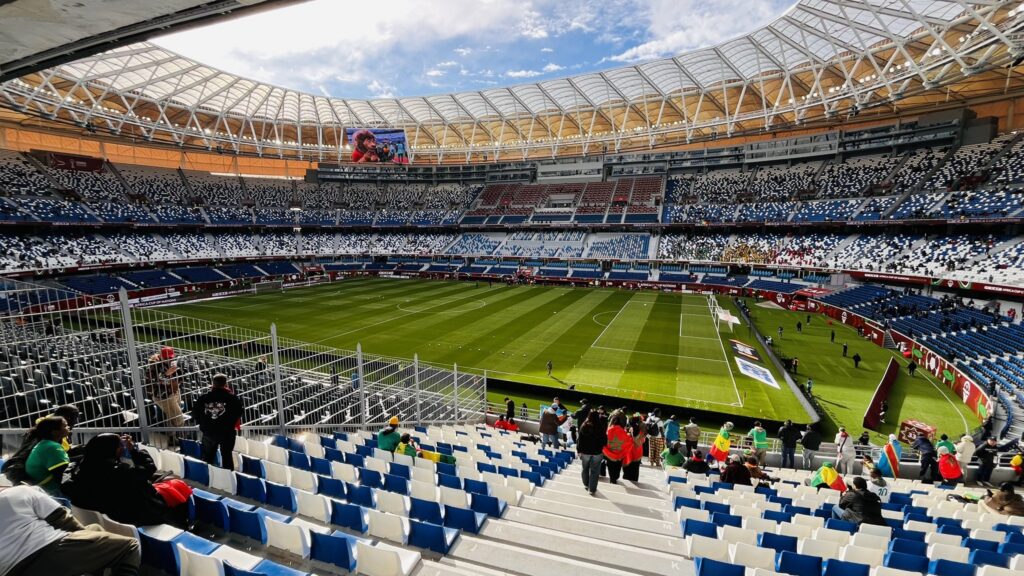
Morocco has developed one of Africa’s most recognisable football stadium networks, with major venues in Rabat, Tangier, Casablanca, Agadir, Marrakech and Fez. From the home grounds of leading Botola Pro clubs to the arenas used by the Atlas Lions and international competitions, stadium capacity is an important part of the country’s football story. This guide to Moroccan football stadium capacities brings together the latest figures published by stadium operator SONARGES and the Confederation of African Football (CAF), while distinguishing current capacities from planned 2030 expansion figures.
Largest football stadiums in Morocco: current capacity
The table below focuses on major football venues with capacity figures published by the organisations responsible for managing or staging competitions at them. Figures can differ between sources because some refer to the current seating configuration, while others describe event or tournament capacity. For that reason, the source and the type of figure matter as much as the number itself.
| Stadium | City | Published capacity | Source / note |
|---|---|---|---|
| Grand Stade de Tanger | Tangier | 72,644 | SONARGES current figure |
| Prince Moulay Abdellah Stadium | Rabat | 68,095 | SONARGES / CAF venue profile |
| Mohammed V Stadium | Casablanca | 45,000 | SONARGES |
| Grand Stade d’Agadir (Adrar) | Agadir | 43,500 | SONARGES current figure |
| Grand Stade de Marrakech | Marrakech | 40,500 | SONARGES current figure |
| Complexe Sportif de Fès | Fez | 35,000 | SONARGES current figure |
| Prince Moulay El Hassan Stadium | Rabat | 22,000 | CAF AFCON 2025 venue list |
| Olympic Stadium (Rabat) | Rabat | 21,000 | CAF AFCON 2025 venue list |
| Stade Al Barid | Rabat | 18,000 | CAF AFCON 2025 venue list |
Capacity note: These are published venue figures, not a guarantee of the number of tickets available for every match. Competition rules, segregation, media areas, hospitality sections, safety arrangements and temporary event layouts can reduce the number of seats offered to supporters.
A closer look at Morocco’s biggest football grounds
1. Grand Stade de Tanger – Tangier
The Grand Stade de Tanger is among Morocco’s largest football venues. SONARGES lists its current capacity at 72,644 seats and says a further increase to 75,600 is planned for 2030. The stadium, opened in 2011, is home to Ittihad Tanger and has hosted major international events. A Moroccan government update published in November 2025 described the renovated stadium as having a capacity of approximately 75,500, while SONARGES currently lists 72,644. These figures may reflect different counting methods or project stages, so this guide uses the operator’s current published figure and notes the discrepancy rather than treating them as interchangeable.
2. Prince Moulay Abdellah Stadium – Rabat
Rebuilt and inaugurated in September 2025, the Prince Moulay Abdellah Stadium has a published capacity of 68,095 seats, according to SONARGES and CAF’s stadium profile. It is a major venue for Morocco national-team fixtures and major continental events. SONARGES lists a planned capacity of 68,700 by 2030. The wider sports complex also includes the Olympic Stadium, an indoor arena and an Olympic swimming pool.
3. Mohammed V Stadium – Casablanca
Mohammed V Stadium remains one of the most historic grounds in Moroccan football. Opened in 1955, it is closely associated with Raja Club Athletic and Wydad Athletic Club and is the traditional setting for the Casablanca Derby. SONARGES lists its capacity at 45,000 seats following modernisation. Its place in the city’s football culture makes it one of the country’s most recognisable stadiums, even though it is no longer the largest by published capacity.
4. Grand Stade d’Agadir – Adrar
Known as Stade Adrar, the Grand Stade d’Agadir opened in 2013 and is the home venue of Hassania Union Sport Agadir. SONARGES currently lists 43,500 seats, with a planned expansion to 46,000 by 2030. The stadium has an athletics track and a natural-grass pitch, and it has hosted major club and international competitions.
5. Grand Stade de Marrakech
Opened in 2011, the Grand Stade de Marrakech is a multi-purpose sports venue with a natural-grass pitch and an eight-lane athletics track. SONARGES lists its current capacity at 40,500 seats and a planned 2030 capacity of 45,860. It has hosted international football events, including FIFA Club World Cup matches, and remains an important venue for football in central Morocco.
6. Complexe Sportif de Fès – Fez
The Complexe Sportif de Fès opened in 2007 and hosts matches involving Maghreb Association Sportive de Fès (MAS). SONARGES lists its current capacity at 35,000 seats, with a major expansion project targeting 55,800 by 2030. This is a particularly important distinction: some tournament and secondary listings have published higher figures, but the stadium operator’s current infrastructure page gives 35,000 as the present capacity.
Rabat’s additional AFCON venues
Rabat’s football infrastructure is not limited to the Prince Moulay Abdellah Stadium. CAF’s official list of Morocco 2025 tournament venues gave the Prince Moulay El Hassan Stadium a capacity of 22,000, the Olympic Stadium 21,000 and Stade Al Barid 18,000. These grounds serve different roles in Moroccan football and demonstrate how the capital’s stadium network extends beyond its main national-team venue.
Which Moroccan stadiums are planned to expand for 2030?
Morocco’s preparations for the 2030 FIFA World Cup include further development of several existing stadiums. SONARGES lists future capacities of 75,600 for Tangier, 68,700 for Prince Moulay Abdellah, 46,000 for Agadir, 45,860 for Marrakech and 55,800 for Fez. These are planned figures, not the current seating capacities stated in the operator’s venue profiles. The Hassan II Stadium project is a separate new-build development and should not be confused with the current capacity of Mohammed V Stadium in Casablanca.
Why stadium capacity figures sometimes differ
Football stadium capacity is not always a single permanent number. A venue may have a gross capacity, a net spectator capacity, a tournament-approved capacity or a temporary event capacity. Seats reserved for media, players’ families, hospitality, security buffers and accessible viewing areas can affect the number of tickets made available. Renovation work can also change the published figure from one season to another. For accurate match planning, fans should always check the organiser’s ticketing information for the specific fixture rather than assuming that the full published stadium capacity is on sale.
Follow Moroccan football with Lions12
From the Casablanca Derby at Mohammed V Stadium to national-team nights in Rabat and Botola Pro fixtures across the country, Morocco’s football grounds are central to the matchday experience. Follow the latest Botola Pro news, results and standings, explore our AS FAR Rabat club profile and Wydad Athletic Club profile, or read our coverage of Botola Pro fixtures and match venues.
Frequently asked questions
What is the biggest football stadium in Morocco?
According to SONARGES, Grand Stade de Tanger currently has 72,644 seats. A 75,600-seat capacity is listed as a planned 2030 figure.
What is the capacity of Prince Moulay Abdellah Stadium?
Its published current capacity is 68,095 seats, with an expansion target of 68,700 by 2030.
How many people can Mohammed V Stadium hold?
SONARGES lists Mohammed V Stadium in Casablanca at 45,000 seats.
What is the capacity of Fez Stadium?
SONARGES lists the Complexe Sportif de Fès at 35,000 seats currently, with a planned expansion to 55,800 by 2030.
Will Morocco increase stadium capacities before the 2030 World Cup?
Yes. SONARGES publishes planned expansion targets for several stadiums, including Tangier, Rabat, Agadir, Marrakech and Fez. These targets should not be described as current capacities until the works are completed and the operator updates its figures.
Official sources and references
- SONARGES – Grand Stade de Tanger: current capacity and 2030 target
- SONARGES – Prince Moulay Abdellah Complex
- SONARGES – Mohammed V Stadium
- SONARGES – Grand Stade d’Agadir
- SONARGES – Grand Stade de Marrakech
- SONARGES – Complexe Sportif de Fès
- CAF – Official Morocco 2025 host cities, stadiums and capacities
- Moroccan government / MAP – Tangier Stadium reopening and expansion update
Editorial note: Stadium capacities were checked against SONARGES and CAF venue information available at the time of writing. Planned expansion figures are labelled separately from current published capacities. Always consult the official match organiser for ticket availability.